

Welcome to the landlord club! Investing in property is a brilliant move, but tackling the taxes can feel like assembling flat-pack furniture without the instructions. This guide is your missing manual for understanding buy to let taxes, designed to make things clear, simple, and maybe even a little bit fun.
Your Guide to Buy To Let Taxes
So, you've taken the plunge into property investment. Fantastic! While dreaming of rental income is the fun part, getting to grips with your tax obligations is what turns a side hustle into a serious success. Let's be honest, tax can seem about as exciting as watching paint dry, but it really doesn't have to be a nightmare.
Think of this guide as your friendly financial translator. We'll ditch the confusing jargon and break down exactly what you need to know about paying tax on your property. Our mission is simple: to swap tax-time anxiety for a clear plan, helping you stay on the right side of HMRC while legally keeping more of your hard-earned cash. The world of buy to let taxes essentially revolves around three key areas you'll need to master.
This visual breaks down the 'big three' property taxes that every landlord will eventually meet.
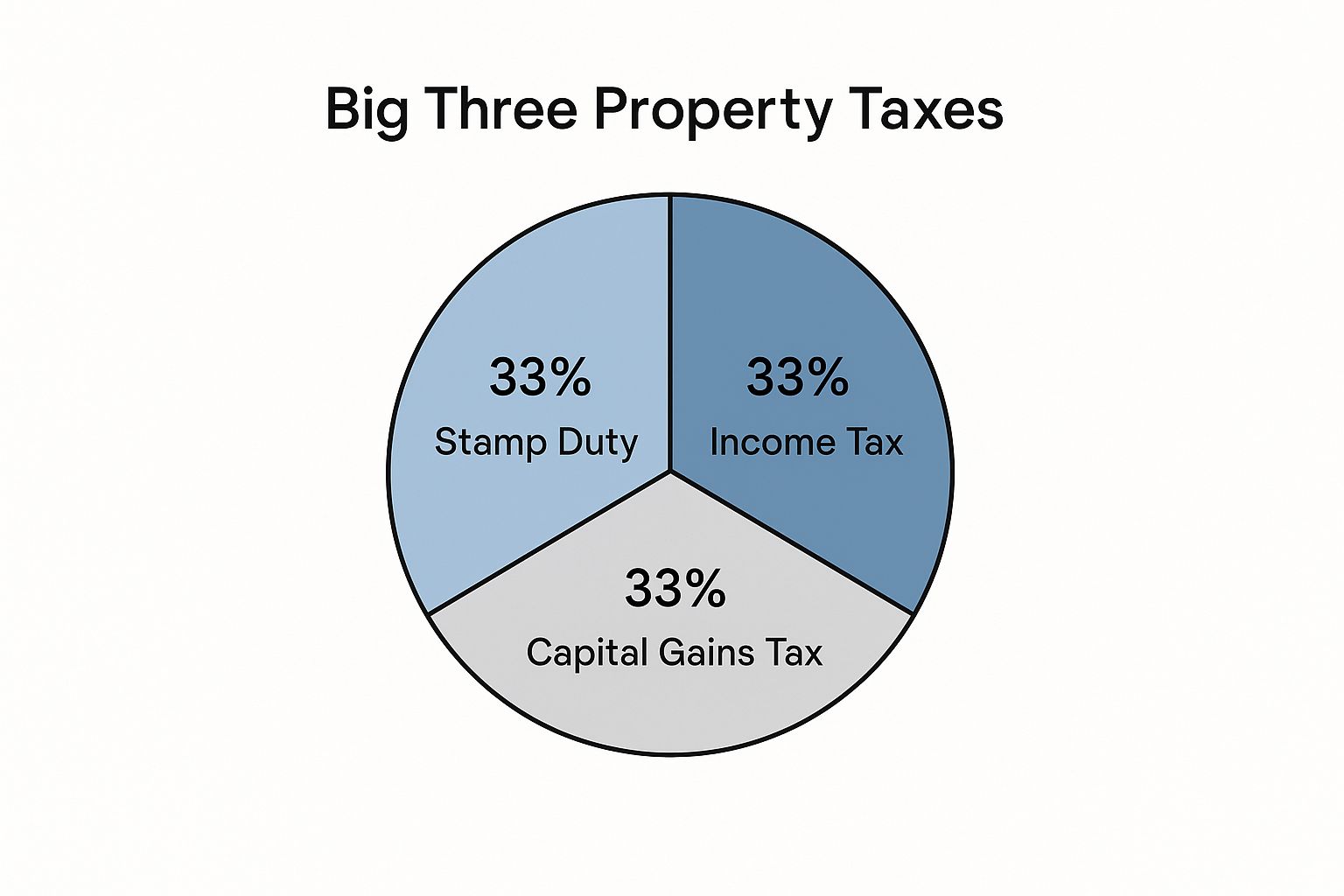
As you can see, Stamp Duty, Income Tax, and Capital Gains Tax are the core components you’ll manage throughout your property journey.
The Big Picture for Landlords
The UK's property market is always on the move, and being a landlord means rolling with the punches. Despite shifts in mortgage rates and tax rules, the rental market remains a huge area for investment.
In fact, between 2019-20 and 2023-24, total income from UK property rentals shot up by £8.02 billion—a 17% increase. This just goes to show the strong demand that continues to make buy-to-let an attractive option for many.
Throughout this guide, we'll walk you through the essentials you absolutely need to know:
- Stamp Duty: The first tax you pay when you buy the place.
- Income Tax: The ongoing tax you pay on your rental profits.
- Capital Gains Tax: The tax you might face when you eventually sell up.
Getting a firm grip on these is the first step towards building a profitable property empire. It's all about knowing the rules of the game so you can play it well. For a broader overview, you might find this A Landlord’s Guide to Buy To Let Tax helpful.
Managing your buy to let taxes effectively isn't just about ticking boxes for HMRC; it's about being smart. Understanding the system allows you to make better decisions, from how you buy a property to how you manage your year-end finances.
Ready to get started? Let's dive into the first hurdle every new landlord faces: Stamp Duty.
Understanding Stamp Duty: Your First Hurdle
Before you even get the keys to your new investment property, you’ll run into your first major tax challenge: Stamp Duty Land Tax (SDLT). The best way to think of it is as the cover charge for joining the property investment club. And for landlords, this charge is a bit steeper than for the average homebuyer.

This upfront cost is a massive part of your buy to let taxes budget. Getting it wrong can cause a real financial headache right from the start, so let’s break it down and make sure there are no nasty surprises.
Why Do Landlords Pay More SDLT?
So, what's with the extra cost? Well, if you're buying an additional property (like a buy-to-let) and you already own your main home, you're hit with a higher rate of SDLT. It's a bit like paying for priority boarding on a flight – you're in a different queue to first-time buyers, and that comes with an extra fee.
This higher rate includes a surcharge slapped on top of the standard SDLT rates. The government introduced this to help manage the property market, making it slightly less attractive for investors compared to people just trying to buy a home to live in.
How the Tiered System Works
SDLT isn’t a simple flat tax. It works on a tiered system, which means you pay different rates on different portions of the property's price. Picture it like filling a glass with different layers of a cocktail; each layer gets taxed at its own rate.
For landlords, that surcharge gets applied to each of these layers. Let's walk through a quick example to see how it plays out in the real world.
Example Calculation:
Let's say you're buying a buy-to-let property for £280,000. Here’s how the SDLT bill would be calculated using the higher rates:
- First £250,000: This slice is taxed at 3%. (£250,000 x 3% = £7,500)
- The remaining £30,000: This bit falls into the next band, so it’s taxed at 8%. (£30,000 x 8% = £2,400)
Your total SDLT bill comes to the sum of those two figures: £7,500 + £2,400 = £9,900.
To put that into perspective, a standard homebuyer would only pay £1,500 on the same purchase. That’s a huge difference you need to factor into your initial costs!
Heads up: Stamp Duty has to be paid to HMRC within 14 days of completing the purchase. Miss this deadline, and you'll face penalties. It’s absolutely vital to have the funds ready and make sure your solicitor is on the case.
A Clear Look at the Rates
To make your budgeting a bit easier, here’s a table that lays out the current SDLT bands for buy-to-let properties. Keep this handy when you're analysing potential investments.
Here’s a simple breakdown to help you see how the numbers stack up.
Buy-To-Let Stamp Duty (SDLT) Rates
| Property Value Band | Standard SDLT Rate | Buy-To-Let Rate (With Surcharge) |
|---|---|---|
| Up to £250,000 | 0% | 3% |
| £250,001 to £925,000 | 5% | 8% |
| £925,001 to £1.5 million | 10% | 13% |
| Over £1.5 million | 12% | 15% |
Getting your head around these rates is the key to accurately forecasting your initial investment. By planning for this tax from day one, you can start your journey as a landlord on solid financial footing, ready for the next step—managing the tax on your rental income.
Calculating Tax on Your Rental Income
Once the rent starts landing in your bank account, it's time to get to grips with the next big player in the world of buy-to-let taxes: Income Tax. This is where the real number-crunching begins, but don't worry, it's less scary than it sounds. The key is to remember one golden rule: you're not taxed on your total rental income, you're taxed on your profit.
Think of it like running a sweet shop. You wouldn't pay tax on every single penny customers give you. First, you'd subtract the cost of the sweets, the rent for the shop, and your staff's wages. What’s left over is your profit, and that's the bit HMRC is interested in. It's the exact same principle with your rental property.
Profit Is The Name of The Game
Your mission, should you choose to accept it, is to calculate your rental profit accurately. To do this, you simply take your total rental income for the tax year and subtract all your 'allowable expenses'. We'll dive into what counts as an allowable expense in a bit, but for now, just know these are your secret weapon for legally reducing your tax bill.
That final profit figure is what gets added to your other income (like your day job salary) to figure out which tax band you fall into. For the 2024/25 tax year, the income tax rates in England, Wales, and Northern Ireland are:
- Basic Rate: 20%
- Higher Rate: 40%
- Additional Rate: 45%
Your rental profit could easily push you into a higher tax bracket, which is why understanding your finances is so crucial. When you’re ready to tackle the paperwork, check out our guide on Self Assessment tax returns explained for a step-by-step walkthrough.
The Big Shake-Up: Mortgage Interest Relief
Now, let's talk about the elephant in the room: mortgage interest. A few years ago, a huge change in how you can claim relief for mortgage interest payments shook the buy-to-let world. It’s a bit like your favourite chocolate bar suddenly shrinking but staying the same price – frustrating, but you have to adapt.
Previously, you could deduct your full mortgage interest costs from your rental income before calculating your tax. This was fantastic, especially for higher-rate taxpayers, as it seriously lowered their taxable profit.
However, a big tax reform phased this out. Now, instead of a deduction, you get a tax credit. This might sound like the same thing, but it can make a huge difference to your final tax bill.
Under the current rules, you get a tax credit equal to 20% of your annual mortgage interest. This is taken off your final tax bill rather than being deducted from your income at the start.
This new system means everyone gets relief at the basic rate (20%), no matter if they're a higher (40%) or additional (45%) rate taxpayer. This was a big change, phased in between 2017 and 2020. Landlords now face a different calculation that often means a higher tax bill, especially for those in the upper-income brackets.
Before and After: A Clear Example
To see how this works, let's look at a scenario. Imagine a landlord, let's call her Sarah, who is a higher-rate (40%) taxpayer.
- Annual Rental Income: £15,000
- Annual Mortgage Interest: £5,000
- Other Allowable Expenses: £2,000
Let's compare her tax bill under the old rules versus the new system.
Under the Old Rules (The good old days!)
- Calculate Taxable Profit: £15,000 (Income) – £2,000 (Expenses) – £5,000 (Mortgage Interest) = £8,000
- Calculate Tax Due: £8,000 x 40% (Higher Rate) = £3,200
Under the Current Rules (The new normal!)
- Calculate Taxable Profit (without mortgage interest): £15,000 (Income) – £2,000 (Expenses) = £13,000
- Calculate Initial Tax Due: £13,000 x 40% (Higher Rate) = £5,200
- Calculate Tax Credit: £5,000 (Mortgage Interest) x 20% (Basic Rate) = £1,000
- Calculate Final Tax Bill: £5,200 (Initial Tax) – £1,000 (Credit) = £4,200
As you can see, Sarah's annual tax bill is £1,000 higher under the current system. This change has made accurate accounting and expense tracking more critical than ever.
Getting your head around these sums is the most important part of managing your buy-to-let taxes each year. If spreadsheets make you break out in a cold sweat, don't panic. That's what we're here for.
Mastering Your Allowable Expenses
Think of your allowable expenses as the secret weapon in your landlord toolkit. Getting this part right is how you bring down your tax bill each year. It's not about finding sneaky loopholes; it's about knowing what you can legally claim, making sure you don't pay a penny more to HMRC than you have to.

The basic rule is simple: if you spent money 'wholly and exclusively' on running your property business, it’s probably a deductible expense. These costs are what shrink your total rental income down to your actual taxable profit.
The Golden Rule: Repairs vs. Improvements
One of the most common trip-ups for landlords is getting the difference between a 'repair' and an 'improvement' wrong. This is super important, as getting it wrong can lead to an incorrect tax return.
A repair is an allowable expense, as it just brings something back to how it was. An improvement, however, makes the property better than it was before. You can't deduct improvement costs from your rental income, but don't throw those receipts away! You can use them to reduce your Capital Gains Tax bill when you eventually sell.
Let's look at a classic example. Your tenant rings up about a cracked window.
- Fixing it: You replace the single pane of glass with a new, identical one. That’s a repair, and the cost is deductible.
- Upgrading it: You decide this is the perfect time to replace all the single-glazed windows with brand-new, energy-efficient triple-glazed ones. That’s an improvement, and you can't claim it against your income tax.
The rule of thumb here is 'like-for-like'. If you're replacing something with its modern equivalent, like an old boiler with a new combi-boiler, that’s usually a repair. But if you’re adding a conservatory where there wasn’t one before, that’s a clear improvement.
Common Allowable Expenses You Can Claim
So, what can you actually put on your expenses list? The good news is that most of the day-to-day running costs of being a landlord are deductible. The key is to keep meticulous records of absolutely everything.
Here are some of the most common expenses you should be tracking:
- Professional Fees: This covers your letting agent's fees, what you pay your accountant, or any legal advice.
- Insurance: Landlord insurance policies, including buildings, contents, and public liability cover, are all fully deductible.
- Running Costs: Think of general maintenance, those repairs we just talked about, any utility bills you cover, and Council Tax when the property is empty.
- Advertising: Any money you spend finding new tenants can be claimed.
- Office and Travel Costs: You can also claim for travel costs to visit your property, as well as a portion of your home office expenses if you manage things from home.
It’s also worth noting that while concepts like rental property depreciation work differently in the UK compared to places like the US, understanding all financial aspects of your investment is key.
Getting a firm grip on your expenses is the most direct way to manage your buy-to-let tax bill each year. It all comes down to being organised, knowing the rules, and claiming everything you’re entitled to. If you’re ever in doubt, a quick chat with an accountant can save you a lot of stress and money.
Navigating Capital Gains Tax When You Sell
Fast forward a few years. Your buy-to-let has been a great investment, it’s gone up in value, and you’ve decided it’s time to sell. This is a brilliant moment, but it’s also when you’ll meet the final member of the buy to let taxes trio: Capital Gains Tax (CGT).
Don’t let the name intimidate you. CGT is just the tax on the profit you make when you sell something that’s increased in value. Think of it as HMRC wanting a small slice of the profit you’ve made. The good news is, you’re only taxed on the gain, not the entire sale price.
Working Out Your Capital Gain
Calculating your gain is pretty straightforward – it’s a simple subtraction sum. You take the sale price and deduct what you originally paid for the property. But that’s not all.
This is where your good record-keeping really pays off. You can also deduct certain costs tied to buying, selling, and improving the property over the years.
Here are the key costs you can deduct:
- Buying Costs: Think back to when you first bought the place. You can deduct your solicitor’s fees and the Stamp Duty you paid.
- Selling Costs: Any fees you pay to sell, like estate agent and legal costs, can also be knocked off your gain.
- Improvement Costs: Remember that new kitchen or extension we talked about? Any capital improvements you made—not routine repairs—can be deducted here, reducing your final taxable profit.
Example in Action:
Let's say you bought a property for £200,000 and sold it for £280,000. Your initial gain is £80,000.
But your buying and selling costs (solicitors, SDLT, estate agent fees) totalled £15,000. You also spent £10,000 on that new extension.
Your actual taxable gain is: £80,000 – £15,000 – £10,000 = £55,000.
Your Tax-Free Allowance and The Rates
Everyone gets an annual tax-free allowance for capital gains, meaning the first chunk of your profit is completely tax-free. For the 2024/25 tax year, this allowance is £3,000. It's not as generous as it once was, which makes careful planning more important than ever.
You only pay tax on the gain you make above this allowance. The rate you pay then depends on your Income Tax band for that year.
- Basic-rate taxpayers pay 18% on gains from residential property.
- Higher-rate taxpayers pay 24%.
It's important to know that your capital gain is added on top of your other income for the year. This can be enough to push some basic-rate taxpayers into the higher-rate bracket, just for figuring out their CGT.
What About Potential Reliefs?
In some situations, you might be able to reduce your CGT bill even further. The most common one for landlords is Private Residence Relief. If the property was your main home at any point before you started letting it out, you can claim relief for the time you lived there, plus the final nine months of ownership.
Understanding how to calculate this is a key part of a successful exit strategy. For a more detailed breakdown, you can learn more about capital gains on the disposal of a property in our dedicated guide.
CGT can feel like a final hurdle, but with a bit of forward planning, it's perfectly manageable. If you’re thinking of selling, don’t leave it to chance. Get in touch to work through the numbers and ensure you’re making the smartest decision.
Smart Strategies to Manage Your Tax Bill
Knowing the rules of buy-to-let tax is one thing, but playing the game smartly is how you build a truly profitable portfolio. Let's look at some proactive strategies that can give you more control and potentially reduce your tax bill. Think of this as your financial game plan.

It’s all about making smart choices before the taxman sends you a letter, not after. A little bit of forward-thinking can make a huge difference to your bottom line.
Personal Ownership or a Limited Company?
This is the big question for many landlords. Should you own your properties in your own name or set up a limited company? There’s no single right answer; it’s like choosing between a hatchback and an SUV – it all depends on your journey.
Owning Personally:
- Simplicity: It’s the most straightforward route. The rental profit is just part of your personal income, and you declare it on your tax return.
- Capital Gains: When you sell, you can use your personal Capital Gains Tax allowance, which is a definite plus.
- Mortgage Access: Lenders have traditionally offered a wider and often more competitive range of mortgages to individual landlords.
Using a Limited Company:
- Tax on Profits: The company pays Corporation Tax on its profits. Depending on your personal situation, this rate might be lower than your higher-rate Income Tax.
- Mortgage Interest: This is a major advantage. The company can still deduct the full mortgage interest as a business expense, dodging the restrictions placed on individual landlords.
- Inheritance Planning: It can be easier to pass on shares in a property company to family members as part of your long-term estate planning.
The choice often comes down to your tax bracket and your future plans. If you're a higher-rate taxpayer looking to grow a big portfolio, a limited company starts to look very attractive. However, getting profits out of a company also has its own tax implications, so it needs careful thought.
The Power of Joint Ownership
Another clever strategy is owning a property jointly with your spouse or civil partner, especially if you’re in different tax brackets. If you set up ownership as 'tenants in common', you can decide how you split the rental income.
For instance, if you're a 40% taxpayer and your partner is on the basic 20% rate, you could give them a larger share of the rental profit. This simple move means more of your combined profit is taxed at the lower rate, saving your household money. It's a perfectly legal and effective way to manage your tax.
Become a Record-Keeping Master
Let’s be honest, nobody enjoys admin. But when it comes to buy-to-let taxes, meticulous record-keeping is your best friend. Think of yourself as a financial detective building a watertight case for a smaller tax bill. You need to keep every receipt, every invoice, and every relevant bank statement.
This isn’t just about having proof if HMRC ever comes knocking. It’s about making sure you claim every single penny you’re entitled to. For help exploring the best structure for your portfolio, have a look at our expert buy to let solutions designed for landlords. When you have all the facts at your fingertips, managing your tax becomes far less stressful and much more effective.
Right, let's get into some of the most common questions we hear from landlords. Think of this as a quick-fire round to clear up those nagging tax queries, helping you stay on HMRC's good side without any unnecessary stress.
What If My Rental Income Is Tiny?
Are you only making a small amount from your property? You might not have to declare it at all. The government’s Property Income Allowance lets you earn up to £1,000 in rental income each tax year, completely tax-free.
This is a fantastic little perk for landlords with minimal profits. The catch, however, is that if you claim this allowance, you can't deduct any of your other allowable expenses. It's an either/or situation, so you'll need to do a quick sum to see which option actually saves you more money.
Is Making a Loss a Total Disaster?
Not at all! In fact, a rental loss can be surprisingly useful down the line. If your allowable expenses add up to more than your rental income for the year, you've made a loss. While you can't use this to reduce the tax on your main salary, you can carry it forward.
When you make a rental profit in a future tax year, you can deduct the loss you carried forward, which will shrink your overall tax bill. It's a bit like getting a delayed tax discount—so always make sure you report your losses!
What Are the Key Self Assessment Deadlines?
Missing a tax deadline is an expensive mistake that’s easy to avoid. Here are the key dates you need circled in your calendar:
- Register for Self Assessment: By 5th October following the end of the tax year you need to report.
- File Your Tax Return Online: Midnight on 31st January.
- Pay Your Tax Bill: Also due by midnight on 31st January.
Our best advice? Don’t leave it until the last minute. Getting your figures sorted out early saves a world of stress and ensures you sidestep any of those pesky late-filing penalties from HMRC.
Feeling overwhelmed by the numbers? You don't have to manage your buy to let taxes alone. The experts at Artema Ltd are here to make your life easier, handling the complex stuff so you can focus on growing your portfolio. Book a consultation with us today!