

A good quarterly business review template is your secret weapon. It’s what turns a dreaded, box-ticking meeting into a genuinely useful strategy session. Think of it as a roadmap for looking back at what happened, celebrating the wins, honestly tackling the bumps in the road, and setting a clear, energised path for the next 90 days.
Tired of Pointless Meetings? Let’s Make Your QBR Awesome
Let's be honest, most Quarterly Business Reviews (QBRs) could have been an email. They often dissolve into a painful formality, packed with endless slides and numbers that don’t actually lead anywhere. It’s no surprise that a staggering 72% of senior executives feel they’re often a waste of time. Sound familiar?
But what if your QBR could be the most valuable meeting of the quarter? Imagine a session that actually gets the team excited, clarifies what’s important, and gives everyone a shared sense of purpose. It’s not a myth; it’s just a well-organised meeting. And you’re about to learn how to host one.
Ditch the Dread and Find the Fun
The problem isn't the QBR itself, but how it's run. A great QBR isn't about blaming people for missed targets or showing off flashy-but-meaningless stats. It's a strategic pit stop. It’s that moment where you all huddle around the map, check the fuel, and decide on the best route for the next leg of the journey.
A powerful quarterly business review template helps you do just that. It forces you to focus on what truly matters:
- Celebrating Wins: High-fives all around! Acknowledging achievements is brilliant for morale and shows what's working.
- Honest Reflection: Looking at what went wrong without playing the blame game. Think of it as a group "oops, let's not do that again" session.
- Strategic Alignment: Making sure everyone is rowing in the same direction for the next quarter.
This guide is for leaders who want to transform their QBR from a snooze-fest into a powerful strategic tool. We’ll ditch the jargon and build a straightforward, customisable template that gets real results. Get ready to run QBRs that your team won't actively try to escape. We'll call that a win.
Building Your Master QBR Template Piece by Piece
Putting together a solid quarterly business review template shouldn't feel like wrestling a bear. The key is to build it in logical sections, with each part telling a piece of your business's story. This isn't about creating an endless slide deck; it's about telling a focused, compelling story with your data.
Start by taking an honest look in the rearview mirror. A simple review of the last quarter's goals is the perfect place to begin. What were you hoping to achieve? And, more importantly, what actually happened? This section grounds the whole review in reality, letting you celebrate the wins and frankly assess what fell short.
Next up is the financial health check. A robust QBR template has to get into the numbers that really matter. Revenue is obviously important, but metrics like cash flow and sales trends paint a much clearer picture of your company's stability and momentum.
These are the same kinds of metrics that organisations like the British Chambers of Commerce use in their Quarterly Economic Survey to get a pulse on the UK economy. They gather data from thousands of businesses to understand the bigger picture, and you should be doing the same for your own company.
Wins, Lessons, and Future Plans
This is where the real magic happens. By dedicating a section to 'Wins and Lessons', you create a space for your team to celebrate achievements and, crucially, to analyse mistakes without a culture of blame. It turns the QBR from a dry report into a real opportunity for learning and growth. I've often found that the best ideas come from digging into the things that went a bit sideways.
Finally, you need to map out a forward-looking plan. This part of your template should outline clear, ambitious goals for the next 90 days. It needs to answer the question, "So, what's next?" This ensures everyone walks out of the meeting on the same page and ready to get to work. Keeping detailed management accounts is fundamental to setting realistic and impactful financial goals.
This visual helps show the journey from a messy, unfocused review to a strategic powerhouse.
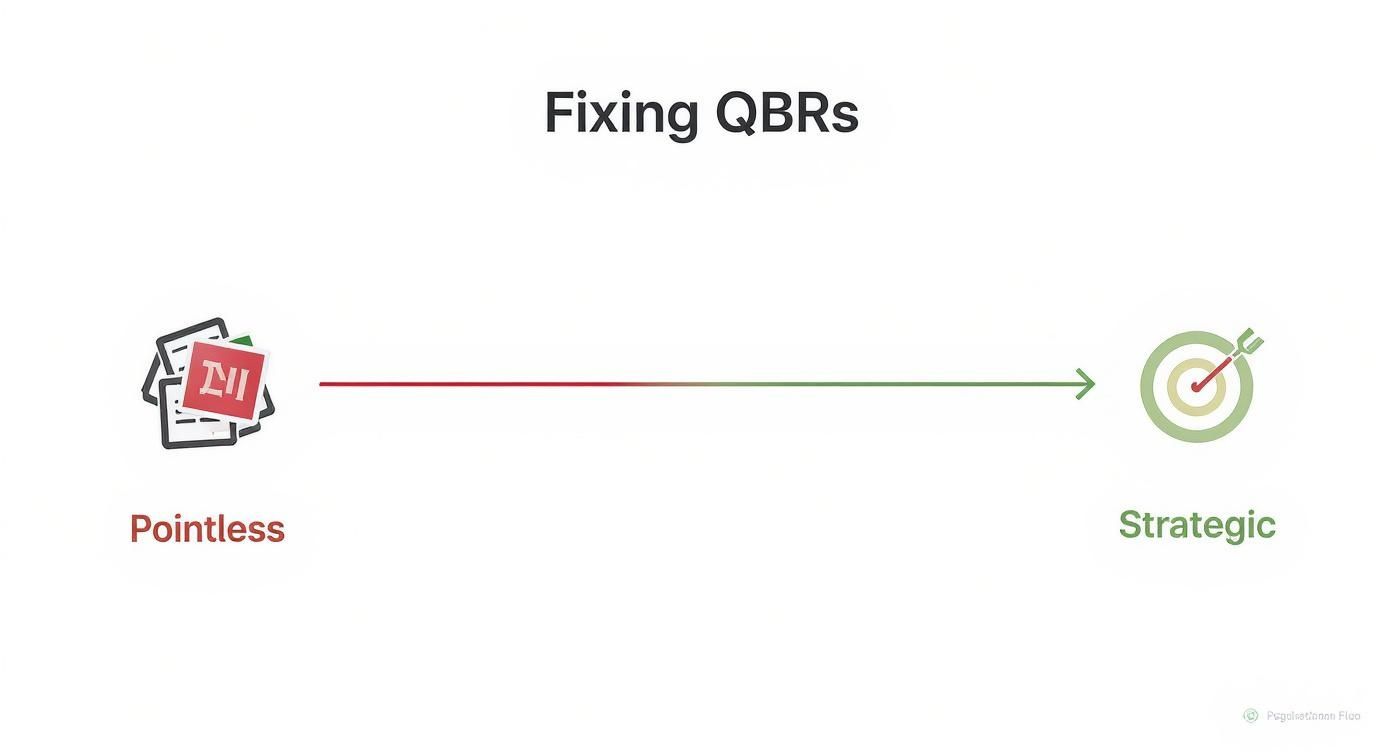
Moving from pointless to strategic is all about structure. You want your review to deliver clear insights that lead directly to things you can actually do.
And while you're building out your QBR, don't forget the basics. Using a simple meeting agenda template can be a lifesaver for keeping the discussion on track and productive.
Choosing Metrics That Actually Tell a Story
Numbers without context are just noise. A QBR template stuffed with meaningless data is the fastest way to put everyone to sleep. Your goal isn't to drown the team in spreadsheets, but to pick a handful of metrics that tell the real story of your business's health.
Think of it like a doctor checking your vitals—they don't run a thousand tests, just the key ones that matter.
The trick is to move beyond the obvious figures. Sure, revenue is important, but what’s the story behind it? Looking at your profit margins tells you whether that revenue is actually translating into a healthy bottom line. A business with high turnover but paper-thin margins might look impressive on the surface, but it could be a sign of trouble brewing underneath.

Similarly, knowing your Customer Acquisition Cost (CAC) is vital. If it costs you £200 to land a customer who only spends £150, you've got a leaky bucket that needs fixing, and fast.
Looking Beyond the Sales Figures
Your sales pipeline data is another goldmine, but only when you present it correctly. Instead of just showing the total value, break it down by stages. This approach quickly flags up any bottlenecks.
Are deals constantly getting stuck in the negotiation phase? Perhaps your pricing is off, or your team needs more support. A good QBR template visualises this flow, making it painfully obvious where the logjams are happening and where the opportunities lie.
Don't just present data; present insights. The question isn't "What are the numbers?" but "What are these numbers telling us to do differently?" Your QBR should spark conversations, not just silent nods.
Customer health is the bedrock of sustainable growth, and it deserves a prime spot in your review. Happy customers stick around, buy more, and tell their friends about you. Unhappy ones? They just quietly disappear.
- Churn Rate: This is the percentage of customers who waved goodbye over the quarter. A rising churn rate is a massive red flag that needs immediate investigation.
- Net Promoter Score (NPS): This classic metric asks customers how likely they are to recommend you. It’s a powerful, straightforward gauge of loyalty and satisfaction.
Tracking customer sentiment is more than a feel-good exercise; it has a direct financial impact. To put this in perspective, UK-listed companies recently issued 64 profit warnings in a single quarter, with one in five blaming weaker consumer confidence. This shows just how quickly customer feelings can hit the bottom line. You can explore more on this in a recent EY report.
To help you get started, here’s a quick guide to pairing metrics with your business goals.
Choosing the Right Metrics for Your QBR
| Business Goal | Primary Metric | What It Tells You |
|---|---|---|
| Increase Profitability | Gross Profit Margin | How much profit you make on each sale before overheads. The good stuff! |
| Improve Sales Efficiency | Customer Acquisition Cost (CAC) | The cost to get a new customer. Essential for sustainable growth. |
| Boost Customer Loyalty | Churn Rate | The percentage of customers lost. A direct measure of how happy they are. |
| Optimise the Sales Process | Sales Cycle Length | How long it takes to close a deal. Highlights any traffic jams. |
| Scale the Business | Customer Lifetime Value (CLV) | The total cash a customer will bring in. Guides your marketing spend. |
Ultimately, picking the right metrics turns your QBR from a backward-looking report into a forward-looking strategy session. It's a critical step, because as our guide on strategy and execution explains, a great plan is useless without the right data to guide it.
How to Run a QBR People Actually Enjoy
Having a brilliant quarterly business review template is a fantastic start, but it’s a bit like having a recipe for a cake without knowing how to bake. The real magic happens in the meeting itself. The goal is to avoid that classic one-way monologue where a presenter just clicks through slides while everyone else slowly glazes over.
Your mission, should you choose to accept it, is to spark a genuine conversation. Think of yourself less as a presenter and more as a talk show host. Your template is your script, guiding the discussion, but you need to draw insights out of your guests—the team.
From Presentation to Conversation
The secret to an enjoyable QBR is making it interactive. Nobody wants to be lectured at for 90 minutes. You need to create an environment where people feel comfortable challenging ideas and sharing their own thoughts.
A simple but powerful trick is to ask open-ended questions throughout. Instead of just stating, "Here are the sales numbers," try asking, "What's the story these sales numbers are telling us?" This small shift completely changes the dynamic from a dry report into a collaborative problem-solving session. To get your QBRs buzzing with energy, it's worth applying some interactive engagement techniques.
The best QBRs feel less like a formal review and more like a strategic huddle. It’s a chance for the key players to get together, look at the game tape, and decide on the winning plays for the next quarter.
Keeping the Energy Up
Managing the clock is crucial, but so is managing the room's energy. Here are a few practical tips to keep things engaging:
- Share the Stage: Don't have one person present everything. Assign different sections of the QBR to various team members. This gives them a sense of ownership and keeps everyone else more tuned in.
- The 10-Minute Rule: Try not to talk for more than ten minutes straight without stopping for questions or discussion. It’s a simple way to break up the monotony and check if everyone is still awake.
- Focus on the "Why": Connect every data point back to the bigger picture. When you discuss a metric, immediately explain why it matters and what it means for the business's future.
Ultimately, a great QBR is all about getting everyone aligned and motivated. When you nail the facilitation, your data becomes a catalyst for real action. By focusing on your team, you'll find that understanding your people is the key to turning a routine meeting into a powerful strategic ritual.
Common QBR Pitfalls and How to Sidestep Them
Even with the most polished quarterly business review template, the meeting itself can easily go off the rails. It happens to the best of us. The trick is knowing the common traps so you can gracefully sidestep them, turning a potential disaster into a genuinely productive session.

One of the biggest pitfalls is when the meeting descends into the dreaded 'blame game'. This is where the review turns into a finger-pointing exercise over missed targets. The tone quickly shifts from constructive to defensive, and any chance of a useful outcome simply vanishes.
Instead of asking, "Who dropped the ball here?", try framing the conversation around, "What can we learn from this, and how do we adjust for next quarter?". It’s a subtle shift, but it fosters a culture of accountability without all the negativity.
Keeping the Big Picture in Focus
Another classic mistake is getting completely lost in the weeds. A QBR isn't the time to pick apart every single detail from the last 90 days. Its purpose is strategic, giving everyone that high-level view of performance and where you're headed.
The best way to avoid this is to stick religiously to the core metrics you defined in your template. If a particular topic clearly needs a deep dive, that's fine—just schedule a separate follow-up meeting for it. This keeps the QBR moving and focused on the big picture. With around 5.64 million small businesses in the UK, staying strategic is crucial for navigating such a competitive landscape. You can find more insights into the UK's business population on gov.uk.
But the most dangerous pitfall of all? No follow-up. A QBR full of brilliant ideas is useless if nothing happens afterwards. It's like a firework show that's all flash and no bang.
This is where your template becomes your secret weapon again. Make sure it has a dedicated section for clear, actionable items. For every decision made in that room, you need to document two things:
- Assign an owner: Who is responsible for seeing this through?
- Set a deadline: By when does this need to be done?
This simple process transforms your QBR from just another talking shop into a launchpad for real progress. It creates clear accountability and ensures the buzz from the meeting actually turns into action, making the whole exercise worthwhile.
Common Questions About QBRs
Let's clear up some of the usual questions that pop up when you're pulling together a quarterly business review. Getting the details right can make all the difference.
How Long Should a QBR Meeting Be?
There's no single magic number, but always prioritise quality over quantity. We find that 90 minutes to two hours is usually the sweet spot. This gives you enough time to get into the good stuff without anyone’s attention starting to wander off to think about lunch. A well-structured agenda is your best friend here.
Who Should Be Invited to a QBR?
Keep the guest list tight. This isn't an all-hands meeting; it's a focused strategy session. You should only invite key people whose input is genuinely vital for making decisions. Think department heads, team leads, and anyone directly responsible for the outcomes you're discussing. A smaller group always leads to a better conversation.
Think of your QBR as a strategic altitude check. It’s not for inspecting every single tree, but for admiring the whole forest and planning the path forward.
What's the Difference Between a QBR and a Weekly Meeting?
It really comes down to perspective. Weekly meetings are about what’s happening on the ground right now – they’re tactical, focusing on the immediate to-do lists to keep projects moving. They're about the doing.
A QBR, on the other hand, is the 10,000-foot view. It's purely strategic. You're looking back at the big picture over the last 90 days to spot trends, and then setting the direction for the next quarter. It’s far less about individual tasks and all about the overall game plan.
Ready to make your financial reviews more effective? The team at Artema Ltd can provide the clarity and strategic insight you need to turn your data into action. Find out how we can help.