
So, you're taking the plunge into the wonderful world of business! First off, congratulations. Now comes the first big head-scratcher: should you be a sole trader or a limited company?
The core difference is simple: as a sole trader, you are the business. It’s like being a solo artist – simple, direct, and all you. A limited company, on the other hand, is like forming a band. It’s a separate legal 'person', which protects your personal stuff but does come with a bit more paperwork.
Your choice really boils down to what you fancy more—getting started in a flash, or building a fortress for the long term with some tasty tax perks.
Sole Trader or Limited Company: The Quick Answer
Welcome to the first big crossroads on your business adventure. Picking a business structure can feel like choosing a starter Pokémon, but don't worry, it's not nearly as stressful. Are you leaning towards the quick-and-easy sole trader, ready to start trading tomorrow with zero fuss?
Or does the idea of a limited company, with its shiny protective shield for your personal finances, sound more your speed, even if it means a bit more admin? This guide will cut through the noise and help you figure out which path best fits your grand plans.
At a Glance: Sole Trader vs Limited Company
Let's not beat around the bush. To make things super clear, here’s a handy table showing the key differences. No jargon, no fluff – just the facts, side-by-side.
| Feature | Sole Trader | Limited Company |
|---|---|---|
| Legal Status | You and the business are the same thing. Simple as that. | It’s a separate legal 'person'. Think of it as your business's very own alter ego. |
| Liability | Unlimited. If things go pear-shaped, your personal assets could be on the line. | Limited. Your personal stuff (like your house and car) is generally safe from business debts. |
| Tax | You pay Income Tax and National Insurance on all your profits. It's all your income. | The company pays Corporation Tax; you pay tax on the salary & dividends you take out. |
| Admin Burden | Pretty low-key. Just one annual Self Assessment tax return. | A bit more grown-up. Annual accounts, confirmation statements, and tax returns. |
| Privacy | Your details are mostly kept under wraps. | Director and company details are public on Companies House for all to see. |
| Credibility | Can be seen as a smaller fish by some bigger clients or lenders. | Often looks more professional and established. It's got that 'proper business' vibe. |
This quick comparison should give you a good feel for the two flavours. Each has its place, and the "right" one truly depends on you and your business dreams.
This infographic helps you visualise the decision based on what you care about most: safety or profit.
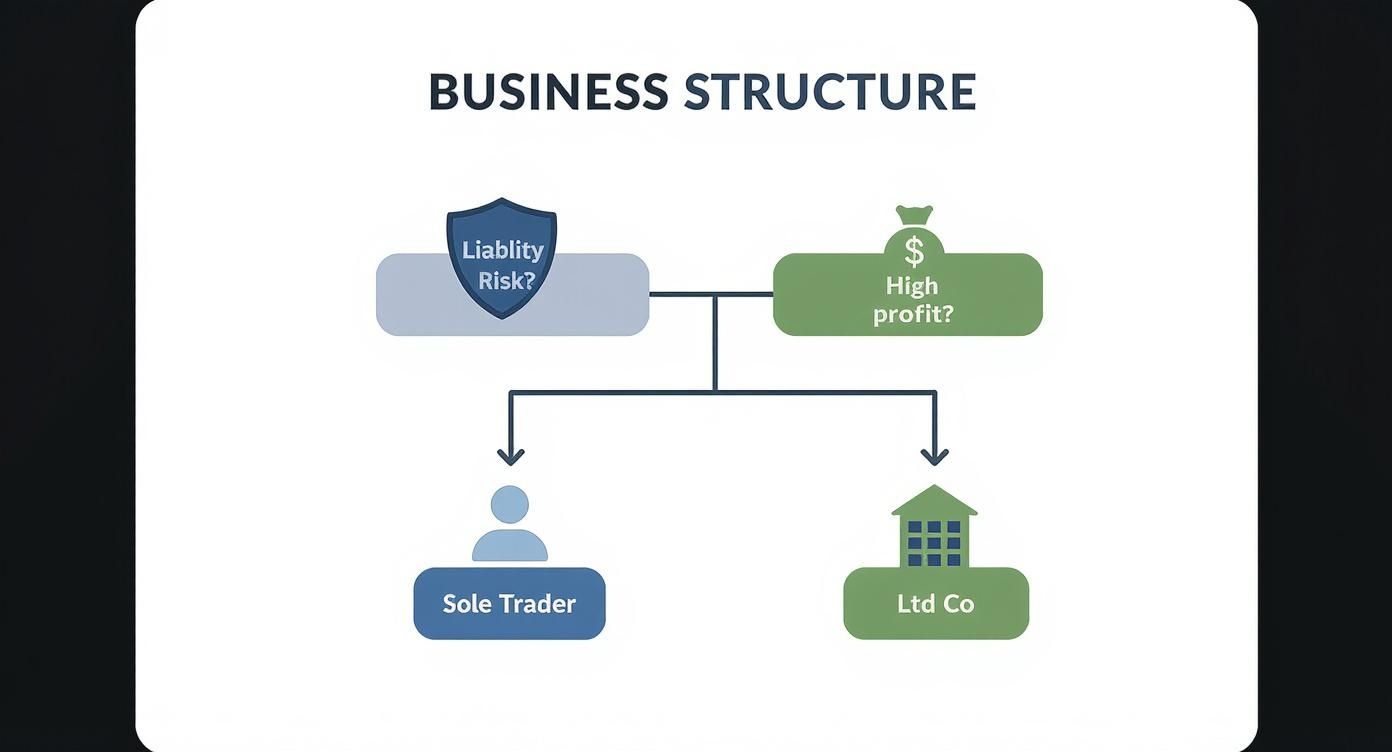
As you can see, if protecting your personal piggy bank is a top priority or you're planning to make some serious cash, the arrow often points towards a limited company. Now that you've got the big picture, let's dive into the juicy details.
Feeling a bit stuck? Don't sweat it! Choosing the right structure is a huge step, and getting some friendly advice can make all the difference. Why not get in touch with our friendly team for a no-obligation chinwag?
The Reality of Being a Sole Trader

Picture this: you’ve got a brilliant idea, a laptop, and a strong cup of tea. That’s pretty much all you need to become a sole trader. It’s the business equivalent of jumping straight into the action—and for many, that’s a massive plus.
You don't need to register with Companies House or deal with any faff. The process is wonderfully simple: you just tell HMRC you’re self-employed, get your special tax number (UTR), and you're officially in business. Easy peasy.
This straightforward approach is why being a sole trader is so popular. In fact, over half of all private sector businesses in the UK are sole traders—a whopping 3.2 million, or 57% of the business population. While limited companies are catching up, the sheer number of sole traders shows just how many people love this easy entry point.
You Are the Business
As a sole trader, you and your business are legally joined at the hip. This gives you complete and utter control. You’re the boss, the finance department, and the chief tea-maker, all rolled into one. Crucially, all the profits are yours to keep (after the taxman has had his share, of course!).
This setup keeps the paperwork blissfully simple, too. Your main admin duty is to file a Self Assessment tax return once a year. This is where you tell HMRC what you’ve earned, claim for your business costs, and pay your Income Tax and National Insurance.
Key Takeaway: The beauty of being a sole trader is its simplicity. You're in full control, there's minimal setup hassle, and you get your hands on the profits without any complicated company stuff getting in the way.
Keeping track of your money is vital, but it doesn't have to be a headache. Understanding how to manage your sole trader accounts is the first step towards feeling like a financial whizz.
The Elephant in the Room: Unlimited Liability
Now for the serious bit. Because you and the business are legally inseparable, you have unlimited liability. This means that if your business gets into financial hot water and racks up debts, you are personally responsible for paying them back. Yikes.
Let's break that down with a simple example:
- Imagine you're a freelance photographer. You take out a business loan for £5,000 for some fancy new camera gear.
- Unfortunately, work dries up, and you can’t make the loan repayments.
- Because of unlimited liability, the lender could chase you for the money personally. This could, in a worst-case scenario, mean they could go after your personal savings or even your car.
This sounds scary, but for millions of freelancers and small businesses with low costs and minimal risk of debt, it’s a perfectly manageable situation. It’s all about being aware and planning ahead. The question of sole trader vs limited company often boils down to how comfy you feel with this personal risk.
If you’re ready to dive in or just want to chat through the numbers, our team is here to help. We can help you weigh up the pros and cons for your specific situation.
Understanding the Limited Company Structure

Ready to put on your director’s hat? Going from a sole trader to a limited company is a bit like upgrading from a solo acoustic act to being the lead singer of a full-blown band. You stop being the business and instead you create one—a brand-new legal entity that stands completely separate from you.
This legal separation is the real magic of a limited company. Your business can now sign contracts, own things, and even take on debt, all in its own name. You're no longer personally on the hook for every single thing; the company takes centre stage.
The Superpower of Limited Liability
By far, the biggest reason people make this leap is for one massive perk: limited liability. Think of it as a protective forcefield that every limited company owner gets. In simple terms, it means if the business runs into financial trouble, your personal assets are generally kept safe and sound.
This is a game-changer in the sole trader vs limited company debate. As a sole trader, you and your business are the same, so business debts could put your personal savings or even your home at risk. A limited company, however, is a separate legal person. This means your liability is usually limited to whatever you’ve put into the business.
So, if your company takes out a loan and can’t pay it back, creditors can typically only go after the company’s assets, not your personal bank account or family car. It's a huge upgrade in peace of mind, especially for businesses that are growing, taking on bigger projects, or looking for investment.
Key Insight: Limited liability creates a financial firewall between your business and personal life. It caps your personal risk, giving you the confidence to take smart business risks without betting the house.
Living in the Public Eye
Of course, this protection comes with a trade-off: a bit more transparency. When you set up a limited company, you have to register it with Companies House, and some of your details become public. This includes things like:
- The company's official registered address
- The names of directors and shareholders
- The company's annual accounts
While this might feel a little exposed at first, it has a big upside. This openness boosts your credibility. Lenders, big clients, and suppliers often prefer dealing with limited companies because they can see the business is legit and get a feel for its financial health. It sends a clear message: "I'm a serious, established business!"
New Hats to Wear: Directors and Shareholders
A new structure brings new roles. The two key players in any limited company are the director and the shareholder. In a small business, you'll almost certainly be both!
- A Director: You’re responsible for the day-to-day running of the company. This is the 'doing' role.
- A Shareholder: You own the company (or a piece of it) through shares. This is the 'owning' role.
This formal setup does mean more admin, like filing annual accounts and a Corporation Tax return. It's precisely why many directors choose to team up with us to handle their company accounts and Corporation Tax, making sure everything is done right and on time.
Feeling like this is the right next step for you? Our team can help you navigate the process of setting up and managing your new limited company. Give us a shout, and let's get your business ready for the big leagues.
Comparing Tax and National Insurance
Right, let’s talk about everyone’s favourite topic: tax. Don't worry, we'll keep it simple. How you settle up with HMRC is probably the biggest difference between these two structures, and it's often the main reason people choose one over the other.
This isn’t about finding sneaky loopholes. It’s about being smart and efficient to keep more of the cash you've worked so hard for. Let’s break it down.
The Sole Trader Tax Experience
As a sole trader, your tax life is refreshingly straightforward. Since you and the business are the same, all your profits are treated as your personal income.
You pay tax on these profits through your annual Self Assessment tax return. It’s a simple sum: add up all your income, take away your allowable business expenses, and what’s left is your taxable profit.
From there, you’ll pay two things:
- Income Tax: This is charged in bands. The more you earn, the higher the rate you pay on the bit of income that falls into the next band.
- National Insurance Contributions (NICs): You’ll pay Class 2 and Class 4 NICs, which go towards your state pension and other benefits.
It’s direct and easy to follow. You earn it, you pay tax on it. Simple.
The Limited Company Tax Approach
This is where things get a bit more interesting – like a financial puzzle with a fun prize at the end. Because your company is its own legal 'person', it has to deal with its own tax bill first.
The company earns a profit, and on that profit, it pays Corporation Tax to HMRC. This is a flat-rate tax, which makes it nice and predictable.
But how do you actually get paid? The company has paid its tax, but that money is still sitting in the company’s bank account, not yours! You have a couple of main options to get the money out, which are often used together for maximum tax-savviness:
- A Small Salary: You can pay yourself a salary as a company director. This is a business expense, so the company doesn't pay Corporation Tax on it. You will, however, need to run a payroll (PAYE) scheme.
- Dividends: Here’s where the magic happens. After the company has paid its Corporation Tax, the profits left over can be paid out to shareholders (that’s you!) as dividends. The tax rates on dividends are much lower than the rates for regular income.
The Big Picture: For a limited company, tax happens in two stages. First, the company pays Corporation Tax on its profits. Then, you personally pay tax on the money you take out. By using a clever mix of a small salary and dividends, you can often end up with a much smaller overall tax bill once your profits hit a certain level.
Let's Crunch Some Numbers
The best way to see the difference is with a real-world comparison.
For a business making a profit of £30,000, the difference in your take-home pay is often pretty tiny. At this level, the sheer simplicity of being a sole trader usually makes it the winner.
However, once your profits start to climb, the limited company structure really starts to shine. A sole trader in the UK pays income tax at 20% on income up to £50,270 and a hefty 40% on income between £50,271 and £125,140, plus National Insurance. In contrast, the mix of Corporation Tax and lower dividend tax rates often makes the limited company route far more tax-friendly once profits hit the £60,000–£70,000 mark.
Just remember, as a director, you can't just dip into the company bank account whenever you fancy a takeaway; every penny needs to be properly accounted for. For more on this, check out our guide on borrowing from your company while keeping the tax cost down.
Feeling a bit lost in all the figures? Don't sweat it. This is exactly what we’re here for. We can run the calculations for you and show you exactly which structure would leave more money in your pocket. Why not book a chat with us today?
Navigating Admin and Paperwork
Every business comes with some paperwork, but the size of the pile can vary wildly between a sole trader and a limited company. Let's be honest, nobody starts a business because they love filing forms, so it’s worth knowing what you’re signing up for.
The good news is that neither path requires a degree in bureaucracy. It’s all about finding the right balance between the perks you want and the admin you’re willing to handle.
The Blissful Simplicity of a Sole Trader
If you’re a sole trader, your admin life is about as simple as it gets. Your main event, the big annual task, is your Self Assessment tax return.
Once a year, you’ll log into the HMRC website, declare your income, list your business expenses, and pay your tax. That’s pretty much it. There’s no Companies House to deal with, no public accounts to file, and no separate tax return for your business. It’s a beautifully simple system designed to get you back to doing what you love.
The Admin Reality: As a sole trader, your main job is to keep good records of your sales and expenses. Do that, and your annual tax return becomes a simple tick-box job rather than a frantic shoebox-sorting nightmare.
The Limited Company To-Do List
When you set up a limited company, you’re stepping up a level in terms of admin. It’s not terrifying, but there are more plates to spin. Think of it as the trade-off for the serious perks of limited liability and tax efficiency.
Your annual checklist will look something like this:
- Annual Accounts: You need to prepare and file official accounts with Companies House each year. These become public.
- Confirmation Statement: This is a yearly check-in with Companies House to confirm your company details are still correct.
- Corporation Tax Return: Your company must file its own tax return with HMRC and pay Corporation Tax on its profits.
- Running Payroll (PAYE): If you pay yourself a salary, you’ll need to register as an employer and run a payroll scheme.
It sounds like a lot, and this is exactly why an accountant often becomes a limited company director's best friend. A good accountant doesn’t just file forms; they handle the deadlines, make sure you're compliant, and free you up to focus on growing your business. They turn what looks like a mountain of paperwork into a manageable molehill.
For any business, managing finances effectively is key. To streamline invoicing, reduce errors, and improve cash flow, exploring accounts receivable automation benefits can be a valuable consideration for any business structure.
Admin at a Glance: A Quick Comparison
Let's put the annual duties side-by-side so you can see the difference clearly.
| Annual Task | Sole Trader | Limited Company |
|---|---|---|
| Personal Tax Return | ✅ Yes (Self Assessment) | ✅ Yes (Self Assessment) |
| Annual Accounts | ❌ Nope | ✅ Yes (filed with Companies House) |
| Corporation Tax Return | ❌ Nope | ✅ Yes (filed with HMRC) |
| Confirmation Statement | ❌ Nope | ✅ Yes (filed with Companies House) |
This shows why the sole trader vs limited company decision involves weighing up the paperwork. The extra admin for a limited company is the price of admission for greater protection and potential tax savings.
Feeling a bit overwhelmed by the list? That's perfectly normal. Our team can take all this admin off your plate, leaving you with total peace of mind. Get in touch and let’s make your business life simpler.
So, How Do You Choose the Right Structure?
After weighing up all the pros and cons, which path should you take in the great sole trader vs. limited company debate? The technical details are one thing, but the right choice really comes down to you, your business, and where you want to go.
Think of it like choosing a vehicle. A sole trader setup is like a zippy scooter—perfect for getting around town quickly, cheap to run, and super easy to park. A limited company is more like a sturdy van—it takes a bit more effort to drive, but it’s built for the long haul, can carry a heavy load, and offers proper protection from the rain.
What Does Your Business Journey Look Like?
To help you figure it out, let's meet a few people. See if any of them sound like you.
Scenario 1: The Creative Freelancer
Meet Sarah, a graphic designer. She works from her home office with a handful of lovely clients. Her costs are low, she loves her freedom, and the last thing she wants is more admin.
For Sarah, being a sole trader is a perfect match. The paperwork is minimal, she keeps all her profits directly, and the unlimited liability isn't a huge worry because she isn’t taking out big loans. The simplicity lets her focus on what she does best: making cool stuff.
Scenario 2: The Ambitious Start-up Founder
Now, let’s consider Tom, who is building a new app. He has big plans to hire a team and knows he’ll eventually need to find investors to grow. He also wants to build a brand that looks professional and trustworthy.
Tom is heading straight for the limited company route. The limited liability protects his personal finances as the business grows, and the formal structure makes his venture look more credible and "investor-ready." For his big plans, creating a separate legal entity is the only way to go.
The Big Question: Where do you see yourself in five years? If the answer involves a team, investors, or big growth, a limited company provides the foundation you’ll need. If you see yourself happily independent, a sole trader setup could be your friend for life.
Making the Final Call
Still on the fence? Let's add one more person to the mix.
Scenario 3: The High-Earning Contractor
Finally, there’s Chloe, an IT contractor earning a high day rate. Her annual profits are pushing well into the higher-rate tax bracket. While she loves her independence, she’s keen to be as tax-savvy as possible.
For Chloe, switching to a limited company is a no-brainer. By paying herself a small salary and taking the rest as dividends, she can slash her overall tax and National Insurance bill compared to being a sole trader. The extra admin is a small price to pay for such big annual savings.
Choosing your business structure is a huge decision, but it doesn't have to be a shot in the dark. Your ambitions, your attitude to risk, and your future plans are the best compass you have.
Feeling like you fit somewhere between these examples? That's completely normal. Every business is unique, and a quick chat with an expert can give you the clarity you need. Get in touch with our friendly team at Artema for a no-obligation chat, and let's figure out the perfect path for you.
Still Have Questions?
You wouldn't be the first! Choosing between being a sole trader or a limited company is a big deal, and it’s natural to have a few questions buzzing around. Let's tackle some of the most common ones.
Can I Change from a Sole Trader to a Limited Company Later On?
Absolutely! In fact, it’s a very common move for growing businesses. Lots of people start as a sole trader to keep things simple while they test the waters. Once the profits start rolling in or they decide to take on staff, they make the switch to a limited company.
The process is pretty straightforward. It’s mostly about setting up your new company and then officially moving your business over to it. The key is getting the timing right to make sure it’s as tax-friendly as possible.
Do I Really Need a Separate Business Bank Account?
If you set up a limited company, the answer is a big, flashing, neon YES. Your company is its own legal 'person', which means its money must be kept completely separate from yours. No dipping into the business account for your weekly shop!
For a sole trader, it's not a legal requirement, but we strongly recommend it. Trying to untangle business and personal spending from one bank statement is a recipe for a massive headache come tax time. A separate account makes life so much easier.
Our Top Tip: Whether you’re a sole trader or a company director, get a separate business account from day one. It’s one of the best habits you can get into and gives you a much clearer picture of how your business is actually doing.
What Happens If the Business Fails?
This is a crucial question and it gets right to the heart of the difference between the two.
- As a sole trader, you and your business are the same. This means you are personally on the hook for all its debts (unlimited liability). Your personal assets could be at risk.
- As a limited company, the business’s debts belong to the business. Your personal assets are protected, and your liability is limited to what you've invested (usually just the value of your shares).
Is There a Profit Tipping Point for Switching to a Limited Company?
There's no single magic number, but a good rule of thumb is to start seriously thinking about it once your annual profits are consistently hitting the £30,000 to £40,000 range.
It's around this level that the tax structure of a limited company—taking a small salary and the rest in dividends—often becomes much more efficient than the sole trader route. The savings can start to outweigh the extra admin costs, leaving more of your hard-earned money where it belongs: with you.
Deciding on the right business structure can feel like a maze, but you don't have to navigate it alone. At Artema Ltd, we specialise in helping business owners just like you through these big early decisions. We can run the numbers for your specific situation and give you the clear, straightforward advice you need to move forward with confidence. Get in touch for a no-obligation chat today.