

So, what on earth is a break-even analysis? Let's cut through the jargon. In simple terms, it’s the calculation that tells you the exact moment your business stops losing money but hasn't started making a profit yet. Think of it as your business's financial ground zero—the point where you can finally stop holding your breath and breathe a sigh of relief.
Finding Your Business's Financial North Star
Ever feel like you’re pedalling a bike furiously uphill but not getting anywhere? That's what running a business without a solid grip on your numbers can feel like. A break-even analysis is your trusty compass, pointing directly to your financial North Star—the specific target you need to hit before you can pop the bubbly.
It’s not about getting tangled up in complicated maths or scary spreadsheets. At its heart, this simple calculation gives you crystal-clear clarity. It helps you answer the most fundamental question for any entrepreneur: "How much stuff do I need to sell just to cover my costs?"
Answering this is a massive step towards learning how to create a healthy cash flow for your business.
The Three Key Ingredients of Break-Even Analysis
To find your break-even point, you only need to get your head around three key ingredients. Getting these sorted will make the whole thing feel much less like homework.
| Component | What It Means (In Plain English) | Simple Example |
|---|---|---|
| Fixed Costs | The bills you have to pay every month, no matter what. Rain or shine, these guys are showing up. | Your monthly office rent or software subscriptions. |
| Variable Costs | The costs that are directly tied to making or selling one item. They're the clingy friend of each sale. | The raw materials for a handmade candle or postage. |
| Selling Price | The price you charge a happy customer for one of your awesome products. | The £25 you charge for that amazing candle. |
Once you've got these three numbers, you're not just doing sums; you're building a financial safety net for your business.
This single calculation can stop you from making risky, gut-feel decisions and guide you toward sustainable profitability.
In the UK, understanding this point became crucial for businesses navigating the economic wobbles after the 2008 financial crisis. For example, a small London-based manufacturing company with £10,000 in fixed monthly costs, selling a product for £100 with a £50 variable cost per unit, must sell exactly 200 units to break even. Any less, and they're paying to be in business. Ouch.
Calculating Your Break-Even Point With a Simple Formula
Right, let's get down to the formula. Don't worry, it’s much simpler than the instructions for flat-pack furniture, and I promise you won't be left with any mysterious spare parts at the end. The whole point is to find the exact number of products you need to sell to cover all your costs.
The formula looks like this:
Break-Even Point (in Units) = Fixed Costs / (Sales Price Per Unit – Variable Cost Per Unit)
It might look a bit intimidating at first glance, but let’s break down each piece. Think of it as a recipe where we just need to gather the right ingredients.
This infographic shows the three key components you'll need for your calculation: your steady fixed costs, the per-item variable costs, and the price you charge.
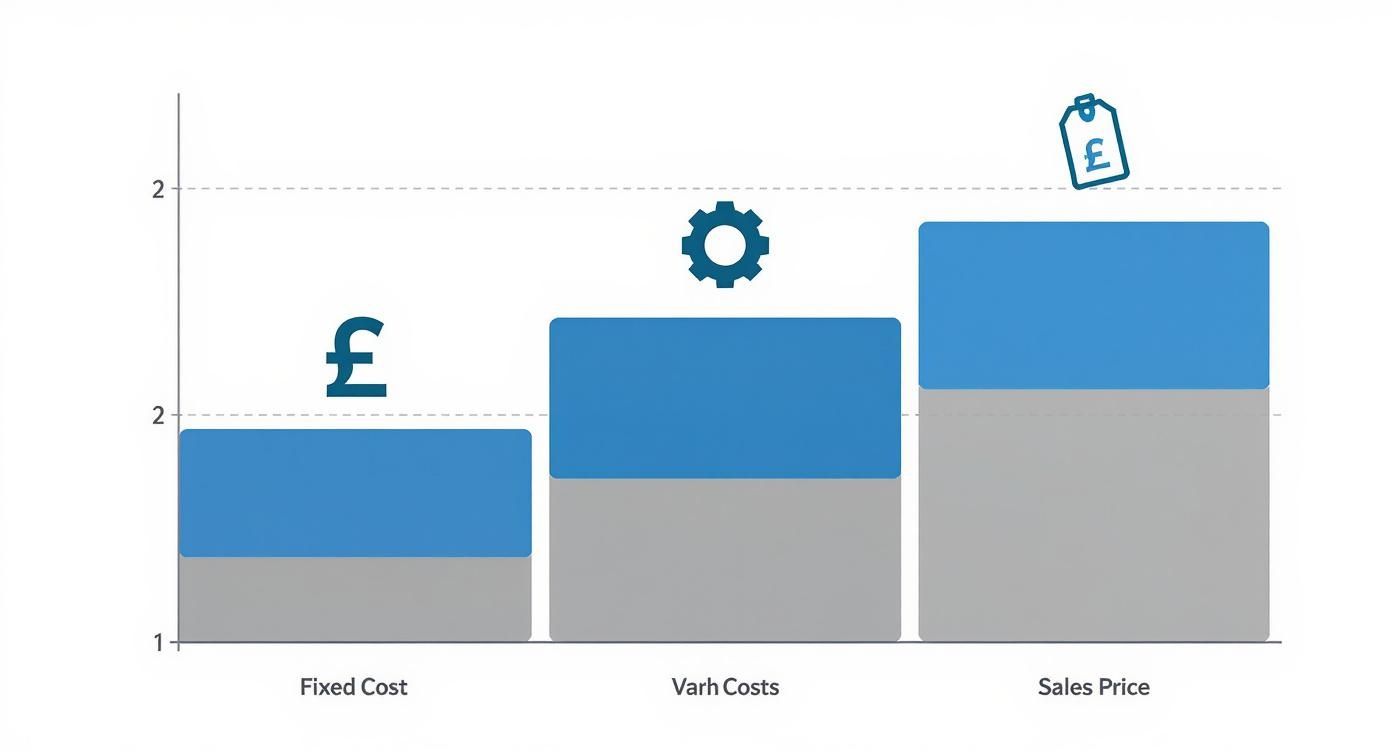
As you can see, the sales price needs to be high enough to cover both types of costs before you can start making a profit on each sale.
The Key Ingredients Explained
Before we start plugging numbers in, let's get comfortable with each component. Getting your head around these terms is the key to mastering your break-even analysis.
-
Fixed Costs: These are your predictable, stubborn expenses that show up every month, whether you sell one item or one thousand. They’re the financial equivalent of a boomerang; they always come back. This includes things like your monthly rent, software subscriptions, insurance, and staff salaries.
-
Variable Costs: Think of these as the clingy friends of your sales. They only appear when you make a sale, and the total amount goes up or down depending on how much you sell. This covers things like raw materials, packaging, and shipping fees for each product.
-
Sales Price Per Unit: This one’s straightforward—it’s simply the amount you charge a customer for a single product or service.
That little bit in the brackets, (Sales Price – Variable Cost), has its own special name: the contribution margin. This is the amount of money from each sale that’s left over to help pay off your fixed costs. Once those are covered, this margin becomes your pure profit. Happy days!
Putting all this into practice is a fundamental part of creating effective business plans and budgets. We'll walk through a practical example in the next section to show you just how easy it is to find your own magic number. So, grab a cuppa and let's see this formula in action.
Seeing Break-Even Analysis in the Real World
Alright, the theory and formulas are sorted. But let's be honest, numbers on a page can feel a bit abstract. The real magic happens when you see break-even analysis doing its job out in the wild.
So, let’s leave the textbook behind and look at how two very different UK businesses would use it.

This isn’t just some theoretical exercise; it’s a core part of strategic planning. In fact, research shows that around 70% of UK small to medium enterprises (SMEs) use break-even calculations in their business plans to manage risk. For instance, a small Manchester retail business with £15,000 in monthly fixed costs and a £30 variable cost per item would need to sell 500 units at £60 each just to cover its bills. You can explore more UK business statistics to see just how widespread these financial health checks are.
Example 1: The Manchester Marketing Consultant
Let's meet Priya, a freelance marketing consultant based in Manchester. She’s brilliant at what she does, but she needs to know how many client projects she must land each month to keep her business afloat and, you know, afford her rent and flat white habit.
First, she lists her fixed costs. These are the bills that arrive like clockwork, regardless of how much work she has on.
- Office Co-working Space: £300 per month
- Professional Indemnity Insurance: £50 per month
- Marketing Software Subscriptions: £150 per month
- Accountancy Fees: £100 per month
Her total fixed costs come to a neat £600 per month.
Next up are her variable costs. For Priya, these are costs directly tied to each project. Let's say she spends about £200 on project-specific software and a bit of outsourcing for each client she works with.
Finally, her selling price. Priya charges a flat rate of £1,000 for a standard monthly marketing package.
Now, let's do the maths:
Break-Even Point = £600 / (£1,000 – £200)
Break-Even Point = £600 / £800 = 0.75 Projects
Obviously, Priya can’t sell three-quarters of a project. This calculation tells her she needs to secure one full client project each month just to cover her costs. Anything after that first one is pure profit. Simple, right?
Example 2: The Edinburgh Bookshop
Now let’s head north to an independent bookshop in Edinburgh run by a chap named Angus. Unlike Priya, Angus sells physical products, but the logic is identical.
His fixed costs are much higher:
- Shop Rent and Business Rates: £2,000 per month
- Staff Wages: £2,500 per month
- Utilities (heating, lighting, Wi-Fi): £300 per month
- Till System Software: £50 per month
Angus’s total fixed costs are a hefty £4,850 per month.
His variable cost is the wholesale price he pays for each book, which averages out at £5. He sells the average book for £10.
Let's run his numbers:
Break-Even Point = £4,850 / (£10 – £5)
Break-Even Point = £4,850 / £5 = 970 Books
Angus needs to sell 970 books every single month before he makes a single penny of profit. This figure is crucial. It tells him exactly what his sales target needs to be just to keep the lights on and the shelves stocked.
These examples show that whether you're selling your time or selling a tangible product, your break-even point is one of the most important numbers in your business. It turns a vague goal of "making money" into a clear, actionable target. Now, let’s explore how you can use that target to make smarter decisions.
Using Break-Even Insights to Make Smarter Decisions
Knowing your break-even point is so much more than a clever trick for accountants; it’s a strategic superpower for your business. Once you’ve calculated that magic number, you can stop guessing and start making genuinely informed decisions that steer your company towards growth.
Think of it as the ultimate risk-reducer. Instead of crossing your fingers and hoping for the best, you have a clear, data-backed safety net. This financial awareness builds confidence, allowing you to take calculated risks rather than blind leaps of faith.

This single number can help you find the answers to some of the most pressing questions you'll face as a business owner.
Fine-Tuning Your Pricing Strategy
One of the first things your break-even analysis tells you is whether your pricing is on the right track. Are you charging enough to comfortably cover your costs and turn a healthy profit? If your break-even point seems terrifyingly high, it might be a sign that your prices are simply too low.
This is where you can start playing around. By adjusting your prices in your calculation, you can immediately see how it affects the number of sales you need. Sometimes, a small price increase can dramatically lower your break-even target, making profitability much easier to achieve. Getting this right is a cornerstone of building a successful business, and you can learn more about how to set prices with our guide to value-based pricing strategies.
Setting Realistic Sales Goals
Vague goals like "sell more" are useless. Your break-even point gives your sales team a concrete, meaningful target to aim for. Now, everyone knows exactly what’s needed just to keep the lights on.
Your break-even point transforms sales targets from arbitrary numbers into a shared mission. Once the team hits that number, every single sale after that is a celebration—it’s pure profit.
This clarity can be incredibly motivating. It helps everyone in the business understand their direct impact on its financial health, turning it from management's problem into a collective team effort.
Making Big Investment Decisions
Are you thinking about making a significant new investment? Maybe it's hiring your first employee, buying a fancy new piece of equipment, or moving into a bigger office. These decisions often feel scary because they almost always increase your fixed costs.
This is where break-even analysis becomes your best friend. Before you commit, you can simply add the new expense to your fixed costs and recalculate. The new break-even point shows you precisely how many more sales you need to generate to make that investment worthwhile. This simple step turns a gut-feeling decision into a smart, strategic move based on solid numbers, empowering you to grow your business sustainably without taking on unnecessary financial stress.
Your break-even number isn't just a static figure; it’s a dynamic tool. When you're facing a tough decision or a new opportunity, plugging the numbers into your break-even formula gives you the clarity to move forward with confidence.
Here’s a quick look at how you can apply these insights to common business challenges:
Applying Break-Even Insights to Business Challenges
| Business Decision | How Break-Even Analysis Helps | Question It Answers |
|---|---|---|
| New Product Launch | Calculates the sales volume needed to cover the new product's costs. | "How many units do we need to sell before this new product becomes profitable?" |
| Marketing Campaign | Adds the campaign cost to fixed expenses to see the required sales uplift. | "Will this marketing spend actually pay for itself in new sales?" |
| Offering Discounts | Models how a price reduction impacts the number of sales needed to break even. | "How many more customers do we need to attract if we run a 20% off sale?" |
| Hiring Staff | Adds the new salary to fixed costs to determine the necessary revenue increase. | "Can we afford to hire a new team member right now?" |
| Changing Suppliers | Shows how a change in variable costs (cost per unit) affects your profit margin and break-even point. | "Is switching to a cheaper supplier worth it if the quality is slightly lower?" |
Ultimately, whether you're adjusting your prices, setting goals, or planning for expansion, your break-even analysis provides a reliable framework. It helps you understand the direct financial implications of every major decision, ensuring your business stays on a path to sustainable profitability.
Common Pitfalls and How to Avoid Them
Break-even analysis is a fantastic tool, but let's be honest—it’s a calculator, not a crystal ball. Relying on it blindly can lead you down a bit of a garden path. Understanding its limitations is the key to using it wisely.
The biggest trap is assuming the world just stands still for you. Your break-even calculation is a snapshot in time, built on the idea that your costs and prices are set in stone. But what happens when your landlord raises the rent or a key supplier bumps up their prices? Suddenly, your carefully calculated break-even point is out of date.
It also completely ignores the beautiful chaos of the market. The analysis works on the assumption that you can sell every single unit you produce. It has no way of accounting for a sudden trend that makes your product an overnight sensation or, on the flip side, a new competitor who starts giving away something similar for free. It’s a bit like planning a picnic assuming the weather will be perfect—a great starting point, but you still need to look out of the window.
Staying Grounded in Reality
To keep your analysis useful, you need to treat it as a living document, not a one-off calculation you tick off a list. Things change, and your numbers have to change with them. This isn't a failure of the tool; it's just a reminder to stay sharp and adapt.
Here are a few classic assumptions to watch out for:
- The "Static Costs" Myth: Your calculation assumes fixed and variable costs will never change. In reality, material costs can fluctuate, and unexpected bills always seem to pop up.
- The "Price is Forever" Illusion: It doesn’t account for special offers, discounts, or the simple need to adjust your pricing over time to stay competitive.
- The "Everything Sells" Dream: The formula tells you how much you need to sell to cover your costs, not how much you can realistically sell. Market demand is a whole different beast.
The core idea behind break-even analysis has been a staple of UK business for decades. Its widespread adoption began in the post-war era when British industries were encouraged to use cost accounting to boost efficiency, establishing it as a standard practice by the 1970s. You can explore more about these historical UK economic trends and see how these foundational tools evolved.
How to Keep Your Analysis Relevant
So, how do you avoid these traps? The answer is simple: regularly review and update your numbers. Think of it as a financial health check-up for your business.
Whenever a significant change occurs—like a rent increase, a new supplier, or a planned price change—run the numbers again. This simple habit turns your break-even analysis from a static, potentially misleading figure into a dynamic guide that helps you navigate the real world of business. It’s about being smart, not just optimistic.
Take Control of Your Business Finances Today
So, there you have it. We've pulled back the curtain on break-even analysis, and hopefully, you can see it’s not some mythical beast guarded by accountants. It’s a practical, powerful tool that belongs in your hands.
Knowing your break-even point is the first real step toward taking proper financial control and building a stable, profitable business.
What comes next is simple: it’s time to stop reading and start doing.
Grab a calculator, fire up a spreadsheet, and get ready to figure out the most important number in your business. You don’t need a finance degree for this, just a clear-eyed look at what it costs to keep the lights on.
The clarity that comes from knowing exactly how many sales you need to cover your bills is empowering. It transforms vague financial stress into a clear, achievable target.
To really get a grip on your finances, it helps to see how break-even fits into the bigger picture. Digging into a simple guide to business finance for your small business is a great next step, as it shows you where this tool sits in your overall financial toolkit.
This knowledge isn't just about surviving; it equips you to thrive.
Start listing your fixed and variable costs right now. Your future, more profitable self will thank you for it. Now go on, give it a go.
Your Break-Even Questions Answered
You’ve got the theory and you've seen the examples. Now, before you start crunching your own numbers, let's clear up a few common questions that might be buzzing around.
What Is a Good Break-Even Point?
That’s a bit like asking, "How long is a piece of string?" The real answer is: a "good" break-even point is one you can realistically hit.
It needs to feel achievable within your regular sales cycle, whether that's monthly or quarterly. If your calculation shows you need to sell 10,000 units a month but your production capacity is only 1,000, you’ve just uncovered a massive red flag in your business model.
Ultimately, your break-even point should be a target that pushes you, not one that makes you want to hide under the duvet.
How Often Should I Recalculate This?
Think of your break-even analysis as a living, breathing document, not a report you file once and forget about. It needs to adapt as your business does.
As a rule of thumb, it's wise to revisit your numbers:
- Quarterly, just as part of a standard business health check.
- When your fixed costs change – for example, if your rent goes up or you hire a new team member.
- When your variable costs change, like when your main supplier puts their prices up.
- If you adjust your product pricing. Running a big sale or increasing your prices will have a direct impact on how many units you need to sell.
Can a New Start-up Use This Without Sales Data?
Absolutely! In fact, this is one of the most powerful moments to do it. For a brand-new business, a break-even analysis isn't about looking back at performance – it’s about testing the entire viability of your idea.
Before you’ve sold a single thing, this calculation helps you answer the most critical question of all: "Is this business model even possible?"
By plugging in your estimated costs and a target sale price, you can see if your business plan is built on solid ground or just wishful thinking. It forces you to get brutally honest about the numbers before you pour in your time and money, making it an essential sanity check for any aspiring entrepreneur.
Feeling more confident about your numbers? That's the first step to gaining real financial clarity. The team at Artema Ltd can help you turn these insights into a robust financial strategy, from day-to-day bookkeeping to long-term growth planning. Visit us to see how we can help your business thrive.